Shanghai University Affiliated Eye Center completes China’s first ZEISS ARTEVO 850-assisted surgery
Dr. Xiao Qirui completed China’s first ICL V5 implantation assisted by the ZEISS ARTEVO 850 digital navigation 3D surgical microscope, marking a new step in high-definition, navigation-enabled refractive surgery.
China’s first ARTEVO 850-assisted ICL V5 surgery completed
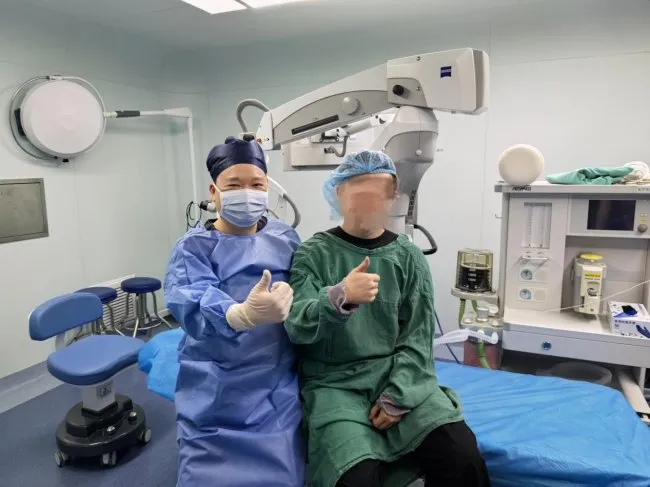
Recently, Shanghai University School of Medicine Affiliated Eye Center (Shanghai Purui Eye Hospital) announced a major clinical milestone. Dr. Xiao Qirui, vice president for medical affairs and director of the refractive surgery specialty, used China’s first ZEISS ARTEVO 850 digital navigation 3D surgical microscope to complete the country’s first ICL V5 implantation assisted by this system for an 18-year-old graduating high-school student, referred to here as Xiao Huang.
The successful procedure marks a new stage for myopia refractive correction in China: one supported by digital navigation and ultra-clear visualization throughout treatment. It also establishes a new clinical benchmark for minimally invasive, precision refractive care.
Xiao Huang had high myopia with regular astigmatism in both eyes and had been affected by myopia for many years. The patient hoped to remove dependence on glasses before entering university, while also having high expectations for daytime visual clarity, nighttime comfort and minimally invasive surgical safety. Conventional refractive options could not fully match these individualized needs.
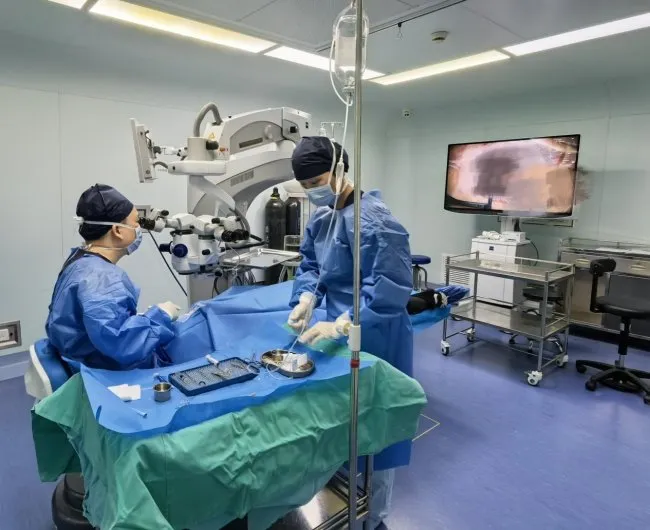
Dual navigation and real-time OCT support precise implantation
Based on Xiao Huang’s examination data and personal goals, Dr. Xiao’s team designed a customized plan using an advanced bilateral single-incision, viscoelastic-free one-step minimally invasive technique together with the new-generation ICL V5 refractive lens.
During surgery, the team used two dedicated core functions of the ZEISS ARTEVO 850 digital navigation 3D surgical microscope to control surgical details throughout the procedure. Intraoperative astigmatism-axis navigation enabled full-process visual calibration of the toric ICL axis, while manual axis marking provided a second quality-control check. Real-time intraoperative OCT vault monitoring allowed dynamic observation of lens position, morphology and key safety values, supporting a smooth, standardized procedure.
The first-day postoperative examination was highly favorable. Xiao Huang’s vision in both eyes recovered rapidly to the expected level, the incisions healed well and there was no ocular discomfort. Daytime vision was clear and transparent, with no glare or halo in low-light nighttime conditions. Lens position, vault and other core indicators all reached optimal clinical standards, fulfilling the patient’s goal of high-quality spectacle independence.
First ARTEVO 850 system installed and clinical cooperation center recognized
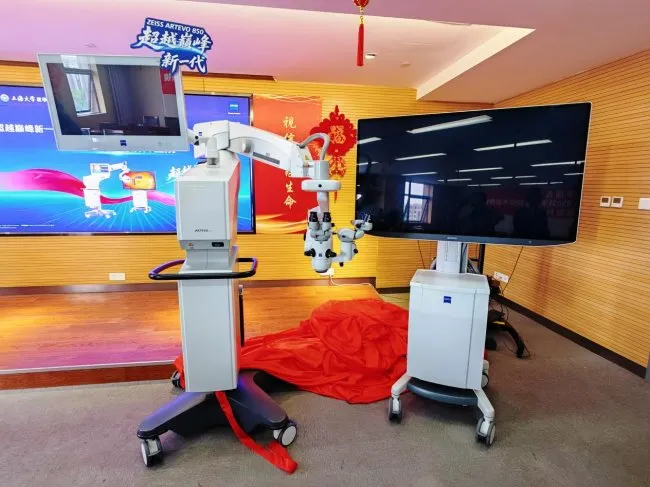
On April 30, 2026, China’s first new-generation ZEISS ARTEVO 850 digital navigation 3D surgical microscope was officially installed at Shanghai University School of Medicine Affiliated Eye Center. The hospital was also officially designated as a first-batch clinical application cooperation center for ZEISS new-generation digital navigation surgery, placing it among China’s core institutions for clinical translation and technical demonstration of digital ophthalmic microsurgery.
According to ZEISS, compared with the previous generation of surgical microscope, the ARTEVO 850 delivers comprehensive upgrades: optical resolution increased by 21%, 3D depth of field improved by 60%, and integration of a dedicated DCA digital filter, full-color-temperature adjustable RGB LED digital light source and a newly updated 3D digital navigation system. These features support ultra-clear imaging, intelligent focusing, low-stimulation minimally invasive illumination and precise tracking.
The system supports a broad range of ophthalmic procedures across specialties. It is suited not only to refractive procedures such as ICL implantation and femtosecond laser correction, helping address delicate challenges in high myopia and astigmatism correction, but also to complex retinal repair, cataract phacoemulsification, minimally invasive glaucoma treatment, vitrectomy and membrane peeling, providing a precise hardware foundation for routine and complex ophthalmic surgery.
Combining advanced equipment and ICL V5 to set a precision refractive benchmark
This first procedure represents the initial clinical combination of the ZEISS ARTEVO 850 digital navigation 3D surgical microscope and the new-generation ICL V5 lens, integrating advanced medical equipment with a mature refractive correction technology. ICL V5 does not require corneal tissue removal and offers high biocompatibility, reversibility, removability and excellent night-vision quality, making it a preferred option for patients with high myopia and astigmatism.
With ARTEVO 850 support, traditional limitations of ICL surgery are reduced: axis calibration no longer depends primarily on clinical experience, and vault assessment is no longer limited to postoperative observation. Safety and quality-control checkpoints move into the full surgical process, forming a three-layer protection system built on clinical experience, standardized technique and digital navigation.
Dr. Xiao has worked deeply in minimally invasive ICL correction for many years and trained under Professors Zhou Xingtao and Wang Xiaoying of Fudan University’s Eye & ENT Hospital. His extensive surgical experience, together with the success of this first case, provides a replicable clinical reference for standardized use of this digital navigation system in ICL practice.
Shanghai University School of Medicine Affiliated Eye Center (Shanghai Purui Eye Hospital) has long followed a patient-centered, technology-driven development philosophy. The hospital continues introducing leading international ophthalmic equipment, bringing together experienced domestic expert teams and building a closed-loop care system that covers preoperative AI planning, intraoperative intelligent navigation and postoperative digital follow-up. The hospital will continue strengthening refractive subspecialty care and providing safe, minimally invasive, high-quality spectacle-independence solutions for people with myopia.